NAO Robot in Education: Lessons for Modern AI Tutors
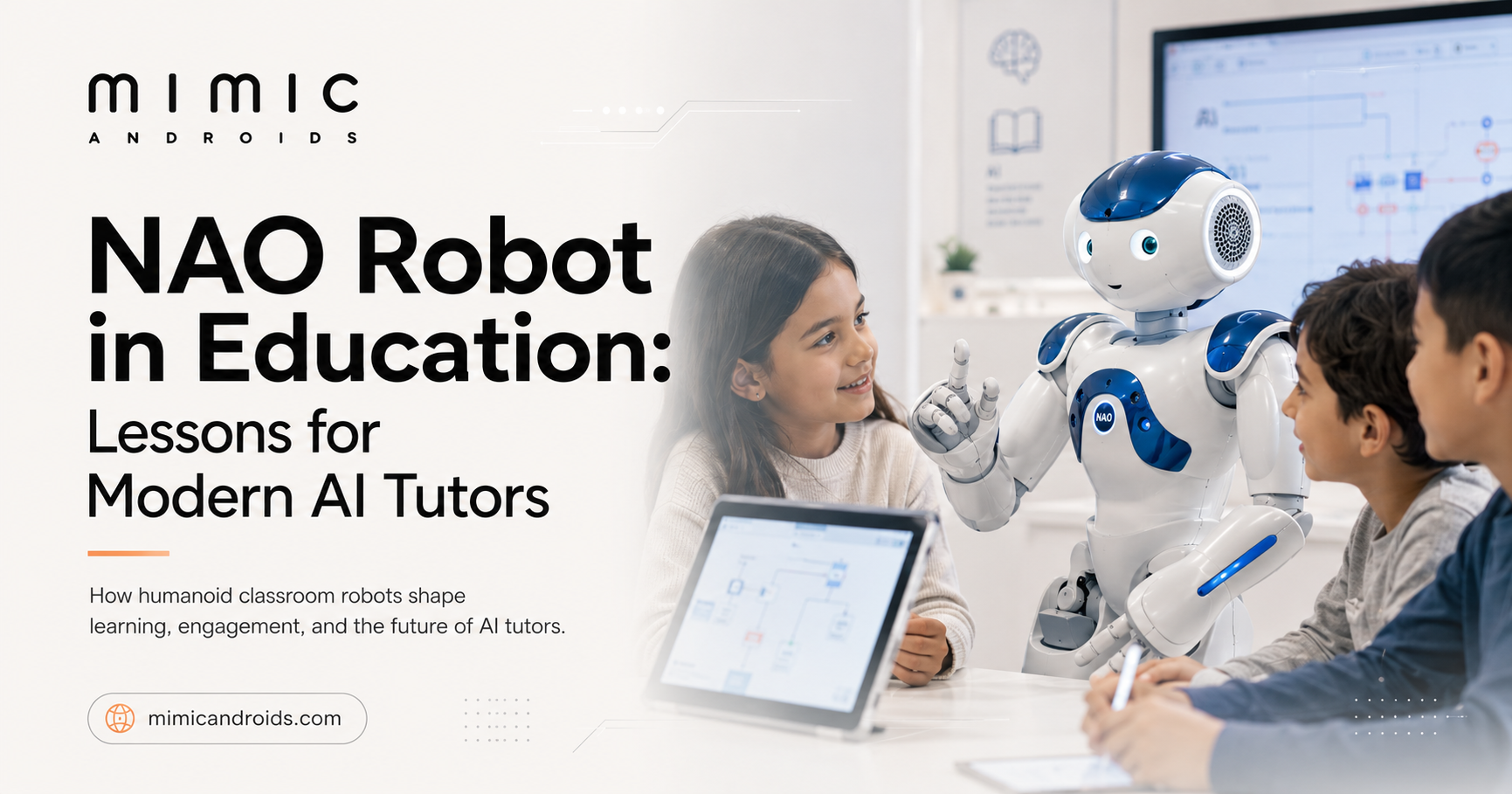
For more than a decade, NAO has been one of the most recognizable classroom robots. While new AI platforms continue to appear, this small humanoid robot remains important in language labs, special education programs, coding workshops, and research projects that explore how learners respond to embodied technology.
NAO Robot in Education is not only a story about one product. It is a case study in what works, what breaks, and what still needs to evolve before modern AI tutors feel like useful learning companions rather than short-lived experiments.
From autism support and language learning to coding and cultural education, NAO has accumulated a rich evidence base in classrooms, clinics, and research environments. This article connects those lessons to the next generation of AI-native tutors, including virtual characters, AI android technology, and digital humans.
Table of Contents
- Why NAO Still Matters in Education
- Technical Profile of NAO as a Learning Companion
- Pedagogical Roles NAO Plays in the Classroom
- What NAO Teaches Us About Intelligent Tutors
- Comparison: NAO vs Other AI Tutor Formats
- Applications Across Ages and Subjects
- Benefits for Schools, Learners, and Researchers
- Future Outlook: From NAO to Modern AI Tutors
- Frequently Asked Questions
- Conclusion
Why NAO Still Matters in Education
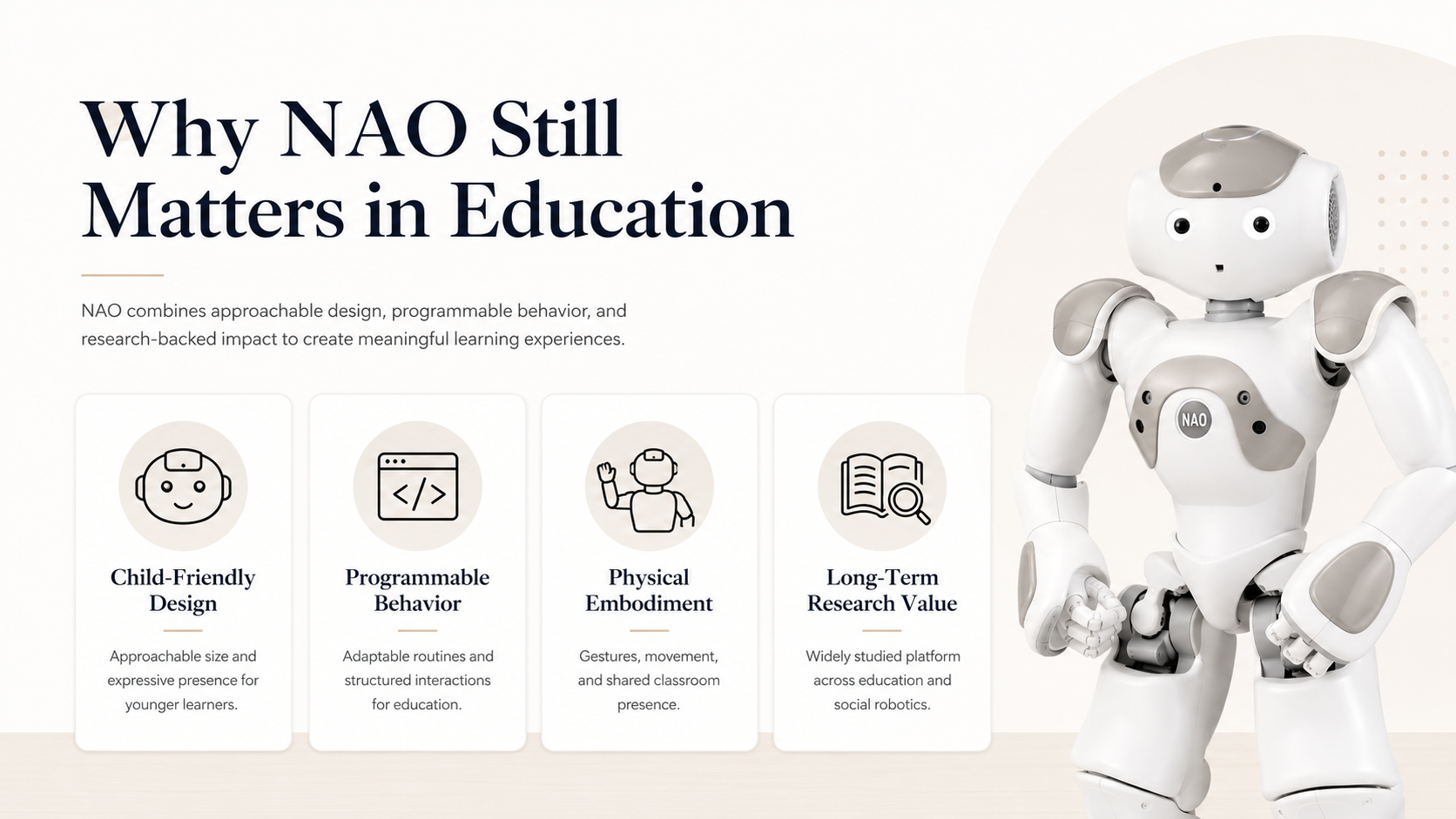
NAO still matters because it represents a rare combination of child-friendly design, programmable behaviour, physical embodiment, and long-term research use. Many education technologies remain screen-based. NAO introduced something different: a small physical character that can move, gesture, speak, listen, and share space with learners.
That physical presence changes the classroom dynamic. Students are not only looking at content on a screen. They are responding to a body in the room. NAO can turn toward a speaker, raise an arm, perform a movement, or act as a social cue during structured lessons.
For educators and researchers, NAO became useful because it was predictable. Lessons could be scripted, repeated, measured, and adjusted. This made it suitable for studies in language learning, robotics education, social interaction, autism support, and human-robot interaction.
Key lesson: Modern AI tutors do not only need smarter models. They also need the right form of presence, trust, timing, and interaction design.
Technical Profile of NAO as a Learning Companion
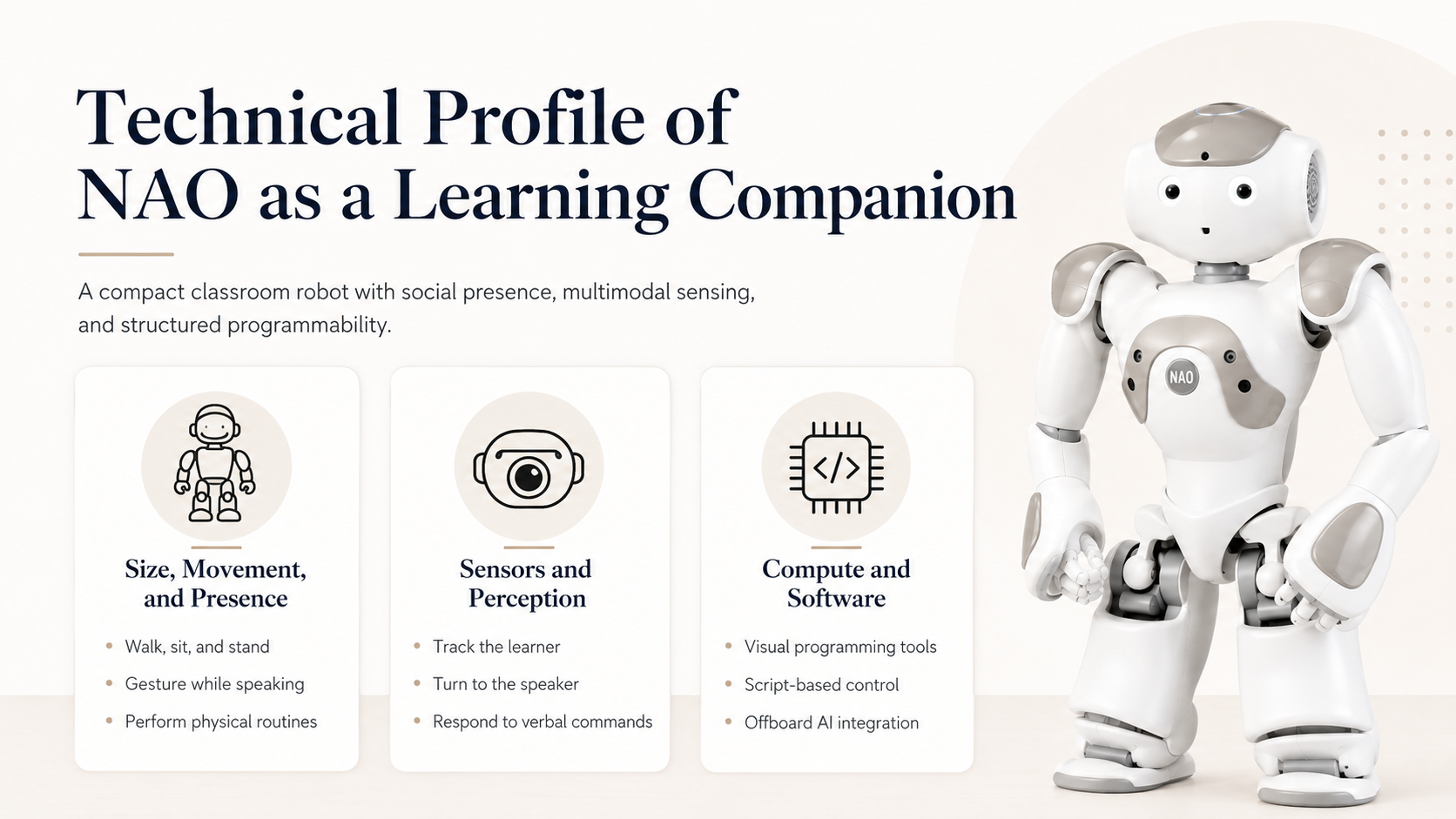
For educational teams, the technical profile of NAO matters because it directly shapes tutor behaviour. NAO is small enough for classrooms, expressive enough for social interaction, and programmable enough for structured learning experiences.
Size, Movement, and Presence
NAO is a compact humanoid robot designed to stand, sit, gesture, walk under controlled conditions, and perform simple physical routines. This gives it a visible presence without feeling too large or intimidating for younger learners.
In practical terms, NAO can:
- Walk, sit, and stand under controlled conditions.
- Gesture while speaking, helping learners follow a lesson.
- Perform simple routines that anchor concepts in movement.
- Use physical presence to support attention and engagement.
Sensors and Perception
NAO includes cameras, microphones, touch sensors, sonar, and inertial sensing, depending on the model and version. These systems allow it to detect basic visual cues, respond to sound, orient toward people, and participate in controlled interactions.
The perception stack is modest compared with current AI standards, but it is reliable enough for structured classroom activities when paired with carefully designed lesson flows and external computing resources.
Compute and Software
NAO runs through the NAOqi software framework, which supports robot behaviour, speech, movement, and application control. For teachers, researchers, and developers, this means lessons can be built through visual programming tools, scripted control, or connected systems.
For education, this creates three advantages:
- Teachers can prepare repeatable classroom demonstrations.
- Students can learn programming through visible robot behaviour.
- Researchers can study how learners respond to embodied agents.
Pedagogical Roles NAO Plays in the Classroom
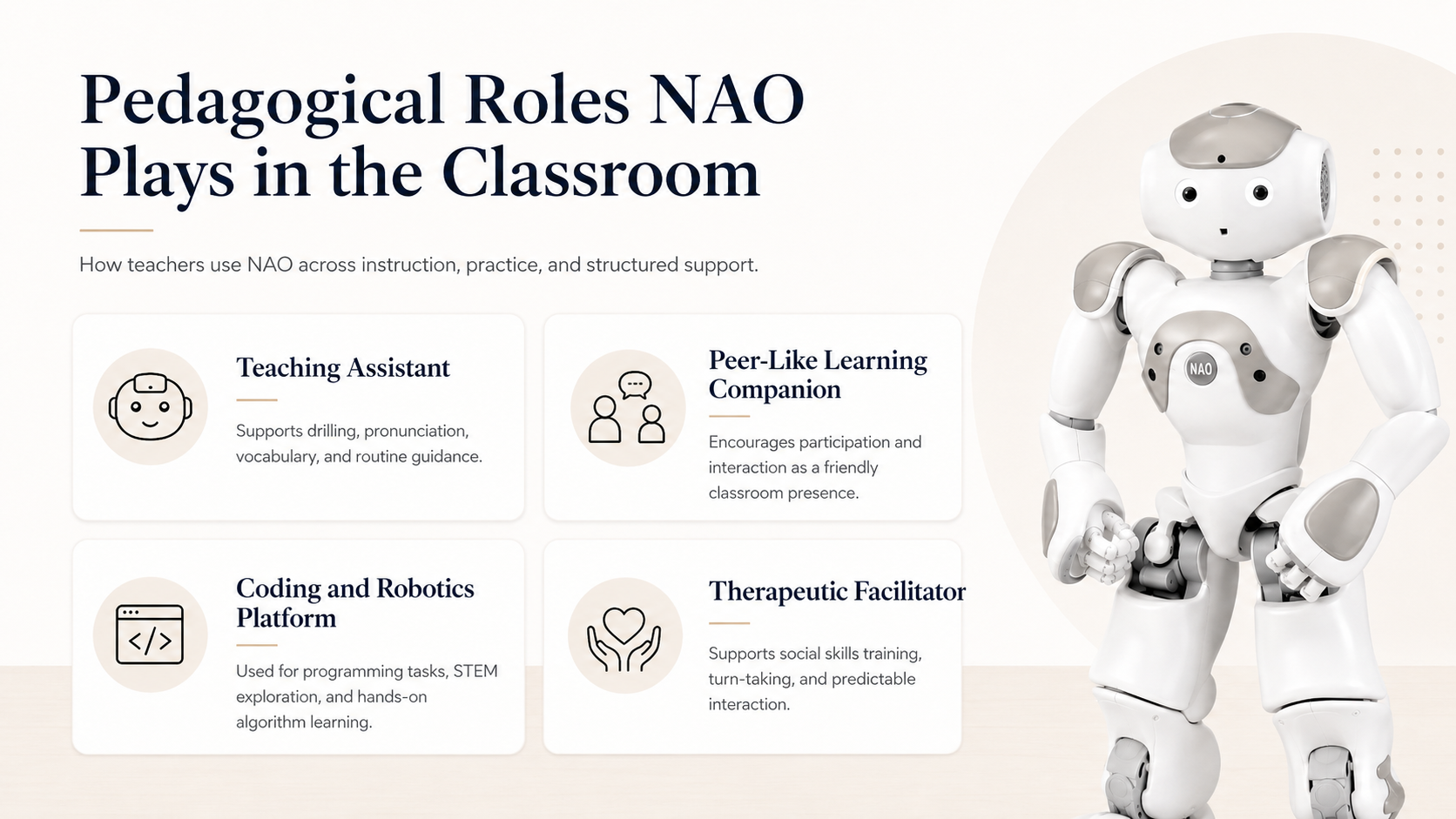
NAO has been used in several educational roles, not only as a novelty robot. These roles show how humanoid robots can support different learning goals when placed inside a thoughtful teaching strategy.
As a Teaching Assistant
In language learning, NAO can act as a consistent teaching assistant. It can repeat vocabulary, demonstrate pronunciation, give simple prompts, and provide immediate feedback. This is useful for repetitive practice that might feel tiring for teachers or intimidating for students.
As a Peer-Like Learning Companion
With younger children, NAO is often positioned as a slightly older peer rather than a strict authority figure. This framing can encourage participation, especially among shy, anxious, or reluctant learners.
As a Coding and Robotics Platform
NAO is widely used in STEM and computing contexts because students can program behaviour and then see the result physically executed by the robot.
As a Therapeutic Facilitator
NAO has also been explored in support contexts for children on the autism spectrum. In structured settings, the robot can help with social routines, turn-taking, imitation, attention, and basic communication practice.
What NAO Teaches Us About Intelligent Tutors
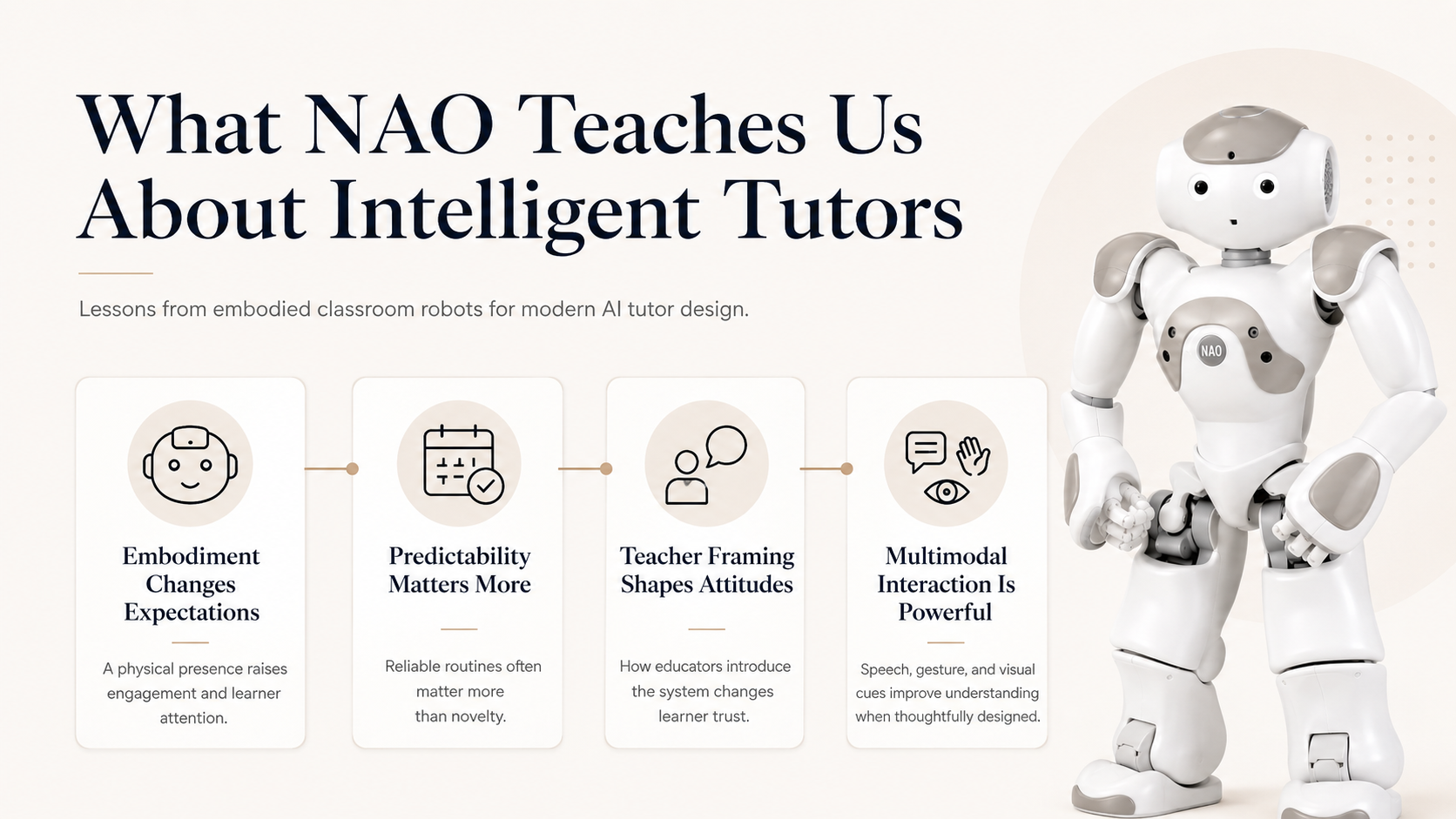
If we look beyond the product name, NAO becomes an early example of a physically embodied AI tutor. From a design and deployment perspective, it offers lessons that apply to modern AI-driven tutoring systems, whether they live in robots, screens, immersive environments, or digital human interfaces.
- Embodiment changes expectations. A robot that can look at you, gesture, and move feels different from a flat interface.
- Predictability matters more than novelty. Initial attention fades unless behaviour and content are aligned with learning goals.
- Teacher framing shapes learner attitudes. When teachers present NAO as a serious assistant, students respond more meaningfully.
- Multimodal interaction is powerful but demanding. Speech, gesture, timing, visual cues, and movement must work together clearly.
These are the same challenges modern AI tutors face today. Whether the tutor is a humanoid robot, a tablet-based agent, or an avatar in a virtual environment, the core question remains the same: how can intelligence become useful, trustworthy, and understandable for learners?
This is where AI android capabilities and AI android solutions become relevant. The next generation of tutors will likely combine conversational AI, digital human realism, simulation workflows, and multimodal interaction.
Comparison: NAO vs Other AI Tutor Formats
To understand the unique contribution of NAO Robot in Education, it helps to compare it with two other common formats for AI-enhanced teaching: screen-based agents and fully virtual tutors.
| Aspect | NAO Humanoid Robot | Screen-Based AI Agent | Fully Virtual Tutor or Avatar |
|---|---|---|---|
| Presence | Physical body and shared space with learners. | Confined to a device screen. | Exists in virtual or mixed-reality environments. |
| Non-Verbal Communication | Gestures, posture, orientation, and proximity. | Limited body language through 2D animation. | Rich animation is possible, but not physically co-located. |
| Classroom Integration | Can participate in group activities and lead routines. | Best for individual or small-group device work. | Strong for remote, immersive, or simulation-based learning. |
| Technical Complexity | Requires hardware, maintenance, charging, and safety planning. | Simpler deployment on existing devices. | Depends on headsets, displays, apps, or web platforms. |
| Scalability | Usually one unit per classroom or lab. | Can scale to many learners if devices are available. | Can scale across virtual cohorts and online environments. |
The comparison is not about choosing one winner. It is about understanding where physical embodiment adds value and where virtual tutors can deliver similar support at lower cost, higher scale, or broader accessibility.
Applications Across Ages and Subjects
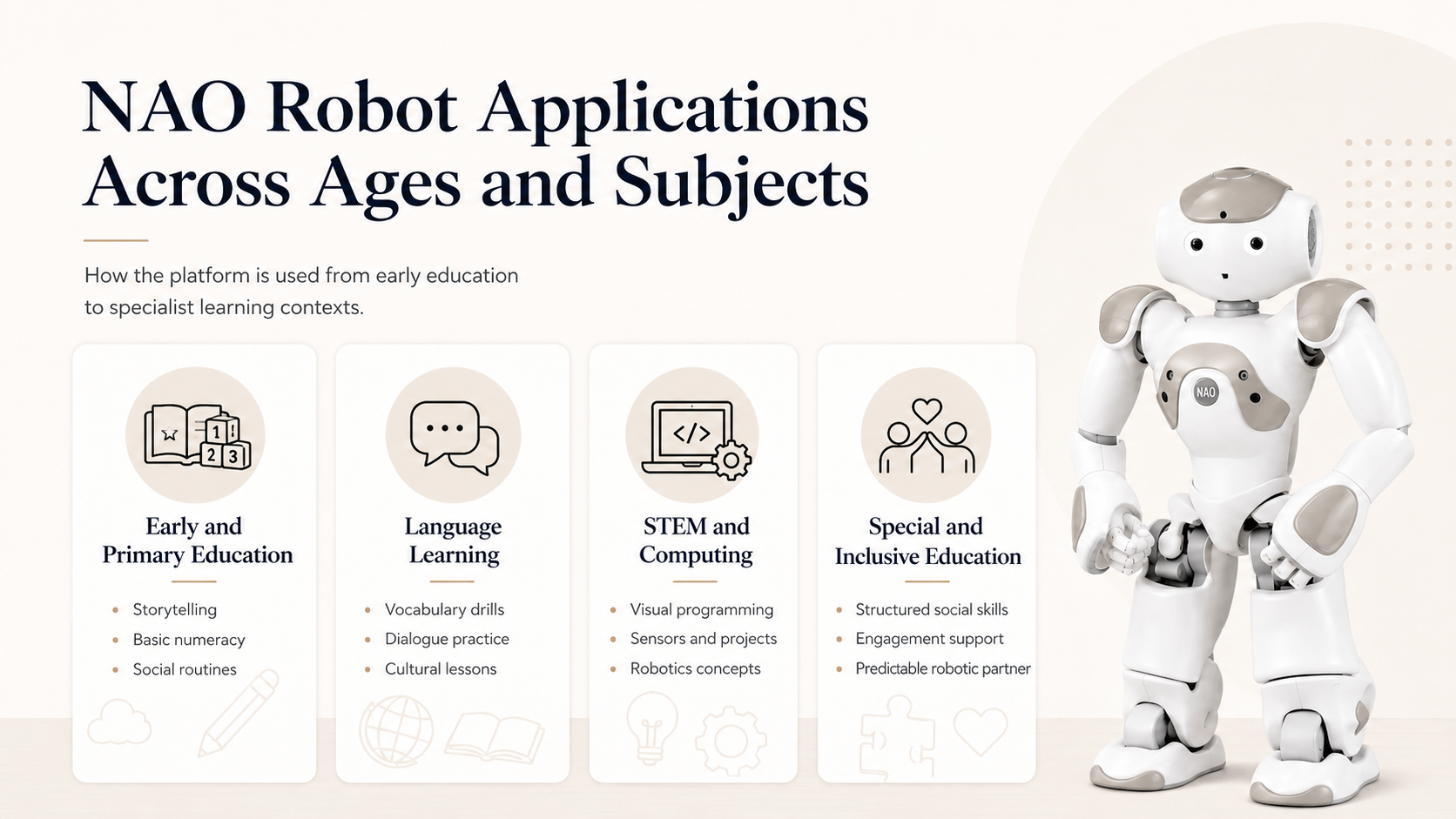
Because of its flexibility, NAO Robot in Education has been explored across many learning contexts, from early childhood to higher education and specialist therapy.
Early and Primary Education
- Storytelling sessions where NAO reads, gestures, and asks comprehension questions.
- Basic numeracy games using physical movement to anchor abstract concepts.
- Social routines such as greetings, turn-taking, and classroom rules.
Language Learning
- Vocabulary drills with speech recognition, repetition, and contextual examples.
- Dialogue practice where learners take roles and NAO responds as a character.
- Cultural lessons where NAO presents traditions, monuments, or geography.
STEM and Computing
- Visual programming tasks where students create simple behaviours and see them executed.
- Advanced projects where NAO interacts with sensors, databases, or external AI services.
- Robotics lessons that teach control logic, sequencing, debugging, and human-machine interaction.
Benefits for Schools, Learners, and Researchers
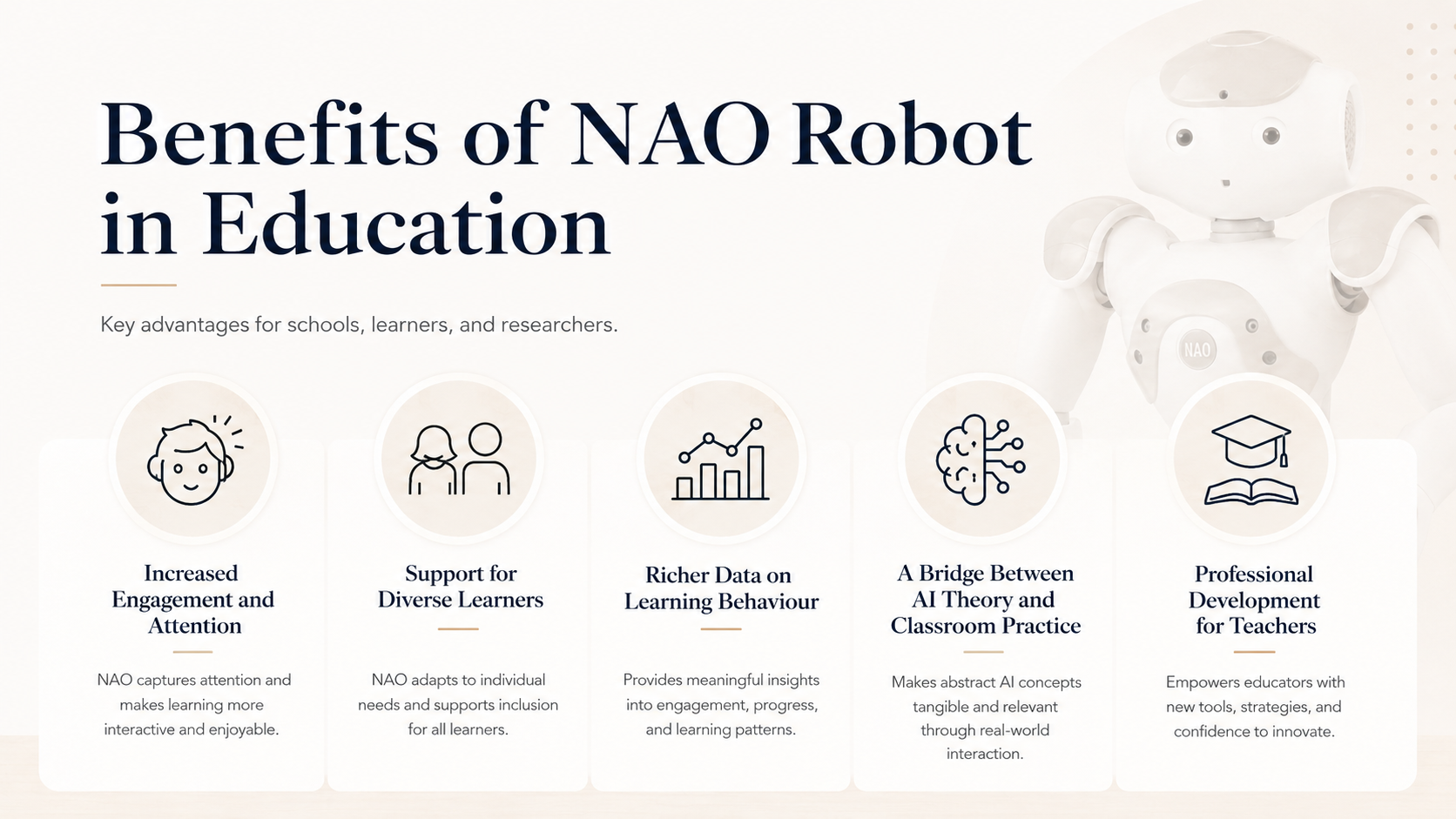
When NAO Robot in Education is integrated as part of a considered program rather than a novelty, several tangible benefits appear.
- Increased engagement and attention: learners often respond strongly to a physical robot during structured interaction.
- Support for diverse learners: predictable robotic partners can help students who struggle with traditional interaction.
- Richer data on learning behaviour: robots can support observation of interaction patterns and response timing.
- A bridge between AI theory and classroom practice: NAO connects human-robot interaction research with real learning environments.
- Professional development for teachers: teachers gain a practical understanding of what AI tutors can and cannot do.
Future Outlook: From NAO to Modern AI Tutors
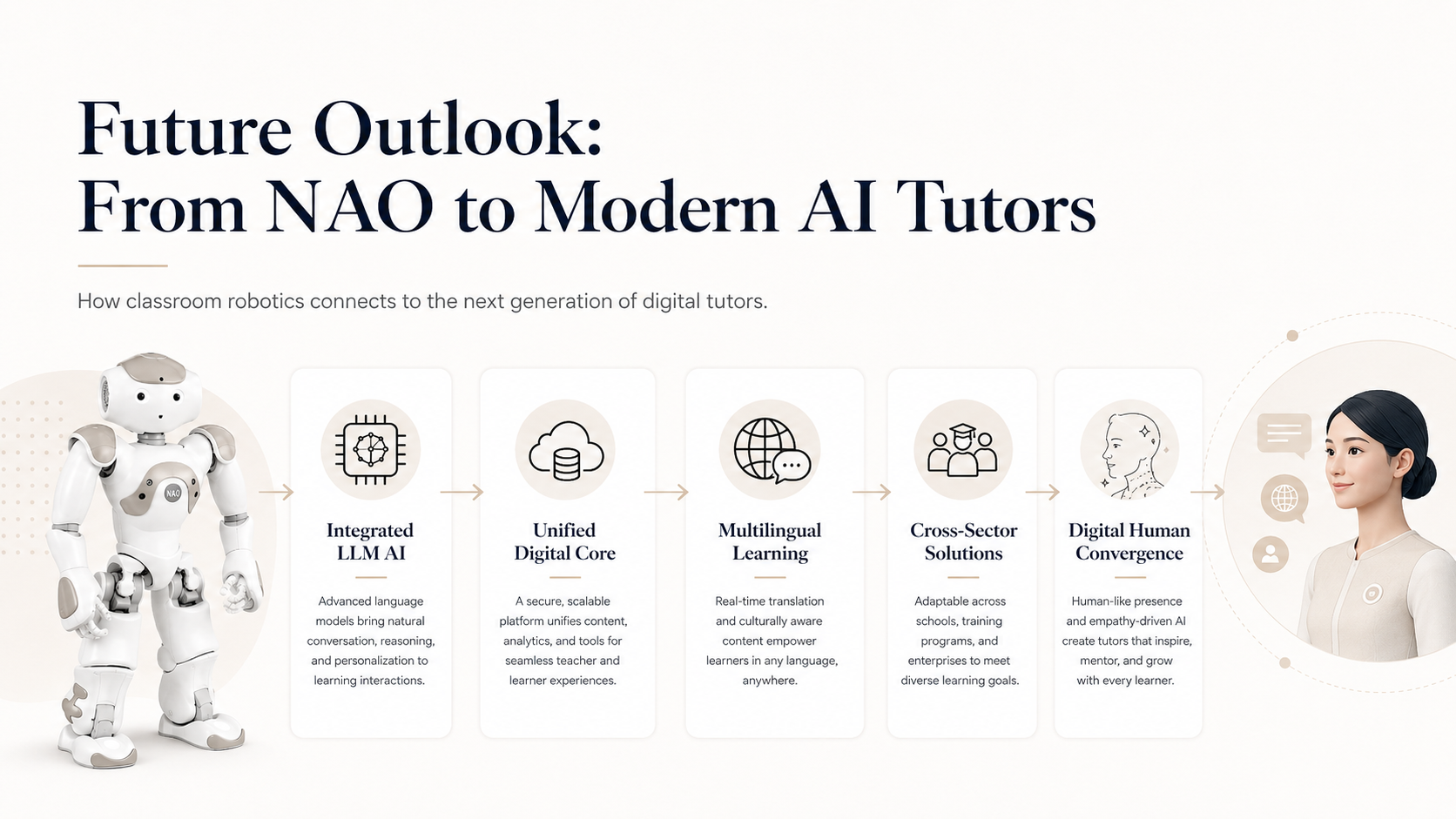
NAO sits at an interesting point in the evolution of AI-supported teaching. It embodies early-generation social robotics, but it is increasingly connected to modern cloud-based AI systems that handle language, perception, and reasoning.
- Advanced language model integration: robots and digital tutors can connect to conversational AI systems for richer responses.
- Shared foundations across physical and virtual tutors: one dialogue pipeline can support a robot, a tablet agent, or a digital human.
- Multilingual and multicultural learning: future tutors will need to move between languages, cultural contexts, and curricula.
- Digital human convergence: modern AI tutors may increasingly appear as realistic avatars or human-like android concepts.
Frequently Asked Questions
What is NAO robot used for in education?
NAO robot is used for language learning, coding education, social skills training, classroom interaction, and research into human-robot learning experiences.
Why is NAO important for AI tutor design?
NAO shows how embodiment, gestures, voice, predictability, and social presence can change how learners respond to intelligent tutoring systems.
Can robots replace teachers in classrooms?
No. Robots like NAO work best as structured learning companions or teaching assistants. They support repetitive practice and demonstrations while teachers guide the learning experience.
How does NAO compare with virtual AI tutors?
NAO offers physical presence and shared classroom interaction, while virtual AI tutors are easier to scale, update, and deploy across devices, web platforms, or immersive environments.
What can modern AI tutors learn from NAO?
Modern AI tutors can learn from NAO’s focus on predictable behaviour, multimodal interaction, teacher framing, and trust in learning environments.
Conclusion
NAO Robot in Education remains important because it shows that learning technology is not only about intelligence. It is also about presence, timing, trust, interaction design, and how teachers frame the role of the machine.
For modern AI tutor design, NAO offers a practical lesson: the future will not be defined only by smarter models. It will be shaped by how those models are embodied, presented, tested, and integrated into real learning environments.