What Are Humanoid Robots and How Do They Work?
What are humanoid robots, and what makes them different from ordinary machines?
Humanoid robots are engineered systems whose body, movement, communication, or social behavior resembles a person. Some have a full humanlike body; others reproduce only the face, head, torso, voice, gaze, or gestures needed for a specific interaction. Their value is not simply that they look human. It is that people can often understand a glance, turn, nod, spoken reply, or pointing gesture without learning a new interface.
The most capable systems combine robotics, perception, conversational AI, animation, and carefully designed behavior. This guide explains how humanoid robots work, why lifelike androids are difficult to build, where they are useful, what influences their cost, and how organizations can evaluate a concept responsibly.
Table of Contents
- What is a humanoid robot?
- How do humanoid robots work?
- Humanoid robot vs android vs digital human
- Where are humanoid robots used?
- Why realism and interaction matter
- How much do humanoid robots cost?
- Frequently asked questions
- Design your android concept
What Is a Humanoid Robot?
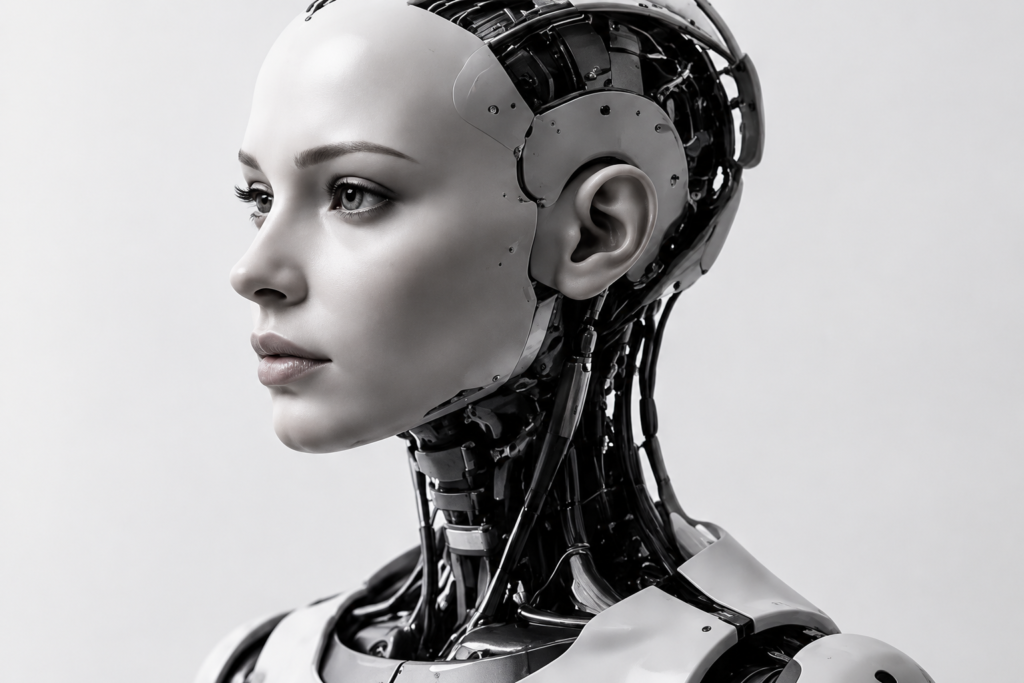
A humanoid robot is a physical robot designed around recognizable human form or behavior. The resemblance may be structural—such as a head, torso, arms, and hands—or social, such as maintaining attention, taking conversational turns, displaying expressions, and responding to people in real time.
Not every humanoid must walk on two legs, and not every useful system needs photorealistic skin. Form should follow the job. A stationary robotic host may need a compelling face, voice, and upper-body gestures but no legs. A research platform may prioritize balance and manipulation. A training guide may exist first as a digital human before any physical prototype is commissioned.
This is why the term covers a wide spectrum: research robots, service robots, robotic faces, telepresence systems, embodied AI agents, and highly realistic android robots. The shared idea is a human-readable interface. Mimic Androids approaches that spectrum through digital human creation, robotic face concepts, AI expression systems, and prototype direction.
The right question is therefore not “How human can the robot look?” but “Which human characteristics make the intended experience clearer, safer, or more engaging?” That shift prevents expensive features from being added merely for spectacle.
How Do Humanoid Robots Work?

Humanoid robots work through a continuous loop: sense the environment, interpret what is happening, choose an appropriate response, and express that response through speech or movement. Each stage can contain several specialized systems.
- Perception: cameras, microphones, depth sensors, touch sensors, or other inputs detect people and events.
- Interpretation: software identifies speech, faces, objects, poses, attention, and context.
- Decision and dialogue: rules, task software, and conversational AI select an answer or action.
- Expression: motors, screens, speakers, facial mechanisms, gaze, and gestures communicate the response.
- Feedback: the system observes the person’s reaction and continues or corrects the interaction.
A convincing interaction depends on coordination. A technically correct spoken answer can feel wrong if the eyes drift away, a smile arrives late, or the body moves while a visitor is still talking. Mimic Androids’ technology approach connects conversational intelligence with gaze, facial expression logic, emotion cues, voice timing, and real-time behavior.
Simulation is valuable because teams can test this loop before committing to expensive hardware. A virtual model can rehearse visitor flows, dialogue paths, sight lines, timing, and failure cases. The Mimic Androids development process combines motion capture, 3D scanning, avatar builds, real-world simulation, prototyping, and optimization to move from an idea toward an interaction system.
Humanoid Robot vs Android vs Digital Human: What Is the Difference?
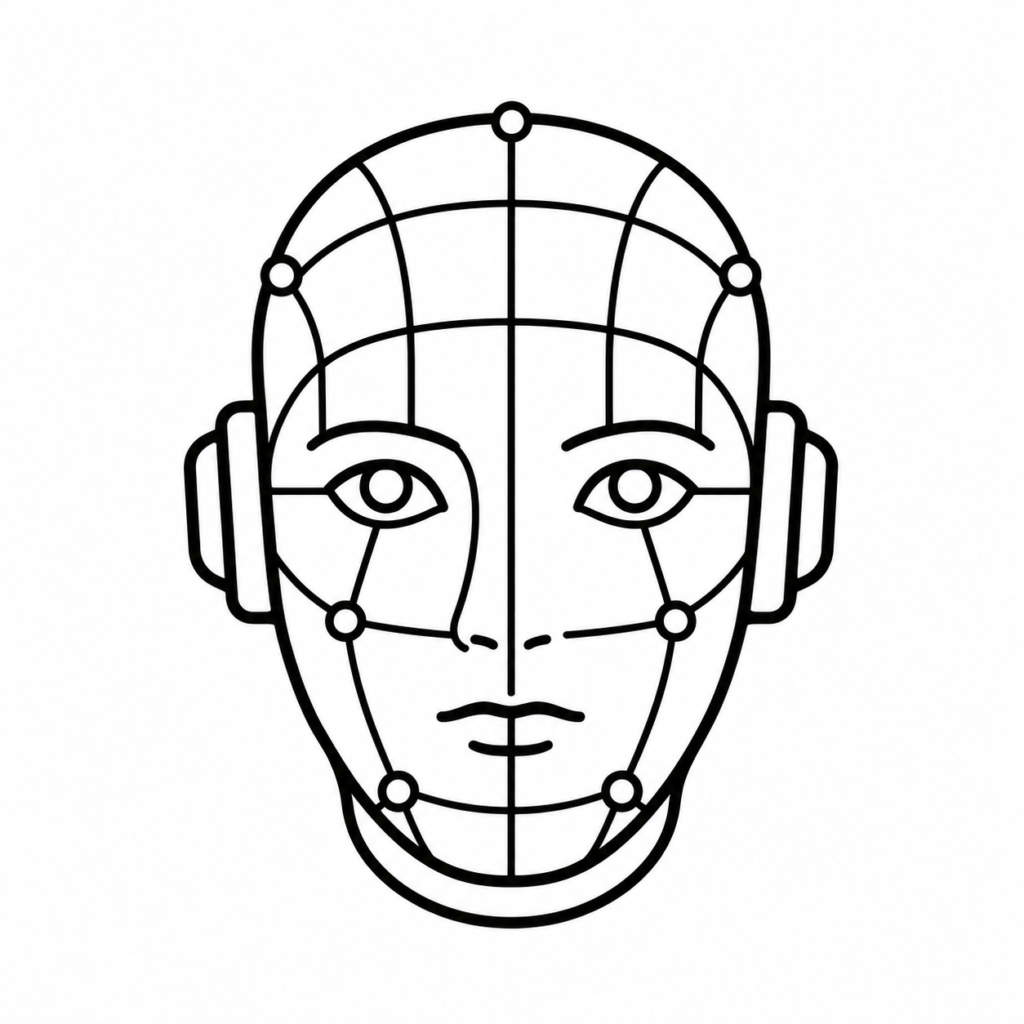
A humanoid robot resembles the human body or behavior. An android is a humanoid designed to look especially human. A digital human is a virtual character that behaves or appears like a person on a screen, in a headset, or inside a simulated environment.
The categories can overlap. A digital human may provide the face, personality, and conversation layer for a physical android. A robotic face may use a digital twin to test expressions. A humanoid platform may use a stylized design rather than realism because its task benefits from clearly looking like a machine.
Realistic humanoid robots create special design demands. People notice tiny inconsistencies in faces and timing: an unblinking gaze, speech without matching expression, or a smile that does not fit the words. More visual realism can raise expectations for behavioral realism. The face, voice, motion, and intelligence must therefore be designed as one experience.
Digital humans are often the fastest place to begin. Teams can explore appearance, voice, personality, and scenarios without building a mechanical body. Once the behavior is validated, selected features can move into a robotic prototype. This simulation-led path is part of Mimic Androids’ broader human-centered design philosophy.
Where Are Humanoid Robots Used?

Humanoid robots are most useful when a task includes communication, demonstration, presence, or navigation through spaces made for people. They should not be chosen just because they attract attention; the form needs to improve the experience or enable the task.
- Reception and hospitality: greeting visitors, answering common questions, explaining next steps, and escalating to staff. See how an AI receptionist and robot front desk can support—not erase—the human welcome.
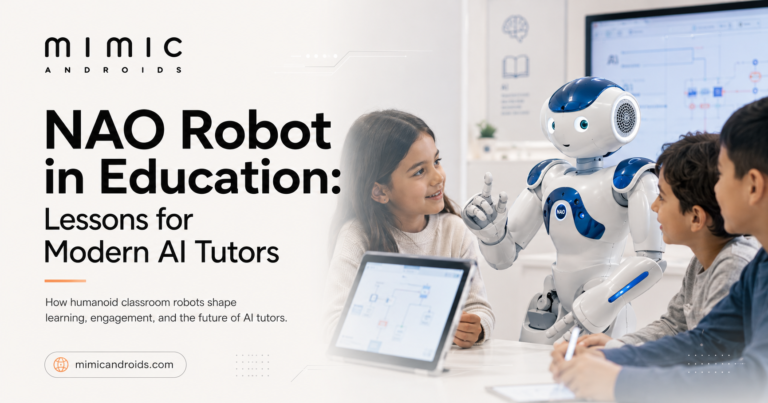
- Education and training: demonstrating procedures, guiding practice, role-playing conversations, and making lessons interactive. The site’s analysis of the NAO robot in education highlights useful lessons for modern AI tutors.
- Retail and events: presenting products, hosting branded experiences, offering directions, and creating memorable demonstrations.
- Healthcare training and wellness support: rehearsing scenarios, delivering consistent prompts, and supporting supervised engagement—not replacing clinical judgment.
- Research: studying human-robot interaction, gaze, trust, expression, collaboration, and embodied intelligence.
- Entertainment: interactive characters, installations, performances, and story-driven experiences.
Mimic Androids develops concepts across these settings through its android solutions for education, events, hospitality, retail, healthcare training, research, and corporate spaces. A strong concept begins with the audience, environment, and outcome rather than a generic list of robot features.
Why Do Realism and Human-Robot Interaction Matter?

People do not experience an android as separate pieces of hardware and software. They experience one social encounter. That means the quality of human-robot interaction depends on coherence: appearance should match ability, expression should match language, and the system should make its limits understandable.
Useful realism is not always photorealism. It can mean believable timing, stable attention, readable gestures, and a consistent personality. A stylized robot with clear cues may produce a better interaction than a realistic face whose movements feel disconnected. Designers should test both performance and audience expectations.
Several principles help:
- Make attention legible. Users should know when the robot is listening, thinking, speaking, or waiting.
- Design graceful failures. If speech is misunderstood or a service is unavailable, the system should recover clearly.
- Preserve human escalation. Users need an obvious route to a person for complex, sensitive, or exceptional situations.
- Avoid deceptive claims. Explain what the system can do and do not imply emotion or understanding it does not possess.
- Test diverse users. Voice, height, mobility, language, culture, lighting, and background noise can change the experience.
The goal is not to make people forget they are interacting with technology. It is to make the technology understandable, responsive, and appropriate. Mimic Androids’ work in digital human realism and interaction behavior treats gaze, expression, timing, personality, and simulation as connected design problems.
How Much Do Humanoid Robots Cost, and How Should a Project Be Evaluated?

There is no single humanoid robot price. Cost varies dramatically because “humanoid robot” can mean a small research platform, a digital character, a robotic head, a stationary service kiosk with expressive hardware, or a full-body mobile android.
The largest cost drivers include mechanical complexity, number and quality of actuators, sensors, computing, batteries, materials, facial realism, safety engineering, conversational software, custom integration, content, testing, maintenance, and support. A prototype designed for a controlled demonstration has different requirements from a system expected to operate every day in a public venue.
Rather than beginning with a shopping question, define the use case:
- Who will interact with it, and in what environment?
- What must the system accomplish in a typical three-minute encounter?
- Which capabilities require a physical body, and which can be digital?
- What happens when the system cannot answer or act?
- How will success be measured—completion, recall, satisfaction, learning, or staff time saved?
- What supervision, maintenance, privacy controls, and safety review are required?
A simulation-first concept can reveal whether a face, torso, screen-based avatar, or mobile body is justified before major hardware commitments. Organizations exploring a custom system can review Mimic Androids’ concept and prototyping capabilities and then define a brief around the real interaction.
Frequently Asked Questions About Humanoid Robots
Are humanoid robots real?
Yes. Humanoid robots already exist as research platforms, service systems, robotic faces, mobile machines, and realistic android prototypes. Their capabilities vary widely, so a demonstration should not be assumed to represent reliable everyday performance.
What is an android robot?
An android robot is a humanoid robot designed to resemble a human closely. It may reproduce facial appearance, expressions, gaze, voice, gestures, or full-body form.
Why are humanoid robots important?
They can use human-readable communication and operate in settings designed around people. Their greatest value appears when embodiment improves teaching, guidance, demonstration, telepresence, research, or social interaction.
Can you buy a humanoid robot?
Some research and service platforms are commercially available, while highly realistic androids are commonly custom projects. Buyers should evaluate the use case, integration, safety, maintenance, content, and support—not only the hardware price.
How much do humanoid robots cost?
Costs range widely and depend on body complexity, mobility, actuators, sensors, realism, AI integration, customization, testing, and support. A scoped concept and prototype are usually needed for a meaningful estimate.
Will humanoid robots replace humans?
Humanoid robots are better suited to defined tasks than to replacing people broadly. Effective deployments assign repetitive or structured interactions to technology while keeping humans responsible for empathy, judgment, exceptions, and accountability.
When will humanoid robots be available for everyday use?
Limited-purpose systems are available now, but broad everyday adoption depends on reliability, safety, affordability, maintenance, and clear value. Adoption is likely to happen task by task rather than through one universal household robot.
Why do many humanoid robots have female-presenting voices or faces?
Designers sometimes inherit stereotypes from service roles or voice-assistant conventions. Responsible teams should question those defaults, test alternatives, and ensure appearance and personality fit the context without reinforcing harmful assumptions.
What is the difference between AI and a humanoid robot?
AI is software that performs tasks such as perception, language, prediction, or decision support. A humanoid robot is a physical embodied system. AI can power its behavior, but motors, sensors, safety systems, and interaction design are also required.
What makes a humanoid robot realistic?
Realism comes from coordinated appearance, gaze, facial movement, voice, gesture, timing, and context-aware response. Visual detail alone is not enough; believable behavior is often more important than photorealism.
From a Humanoid Robot Idea to a Testable Experience
Humanoid robots are not one product category with one price or one ideal body. They are interaction systems that combine embodiment, perception, intelligence, expression, and carefully designed limits. The best projects begin with a real audience and task, then select only the humanlike features that improve that experience.
If you are exploring an android host, digital human, robotic face, research prototype, training guide, or simulation, contact Mimic Androids to discuss a human-centered concept. A focused brief and simulation-led prototype can turn a broad humanoid-robot idea into something your team can see, test, and improve.